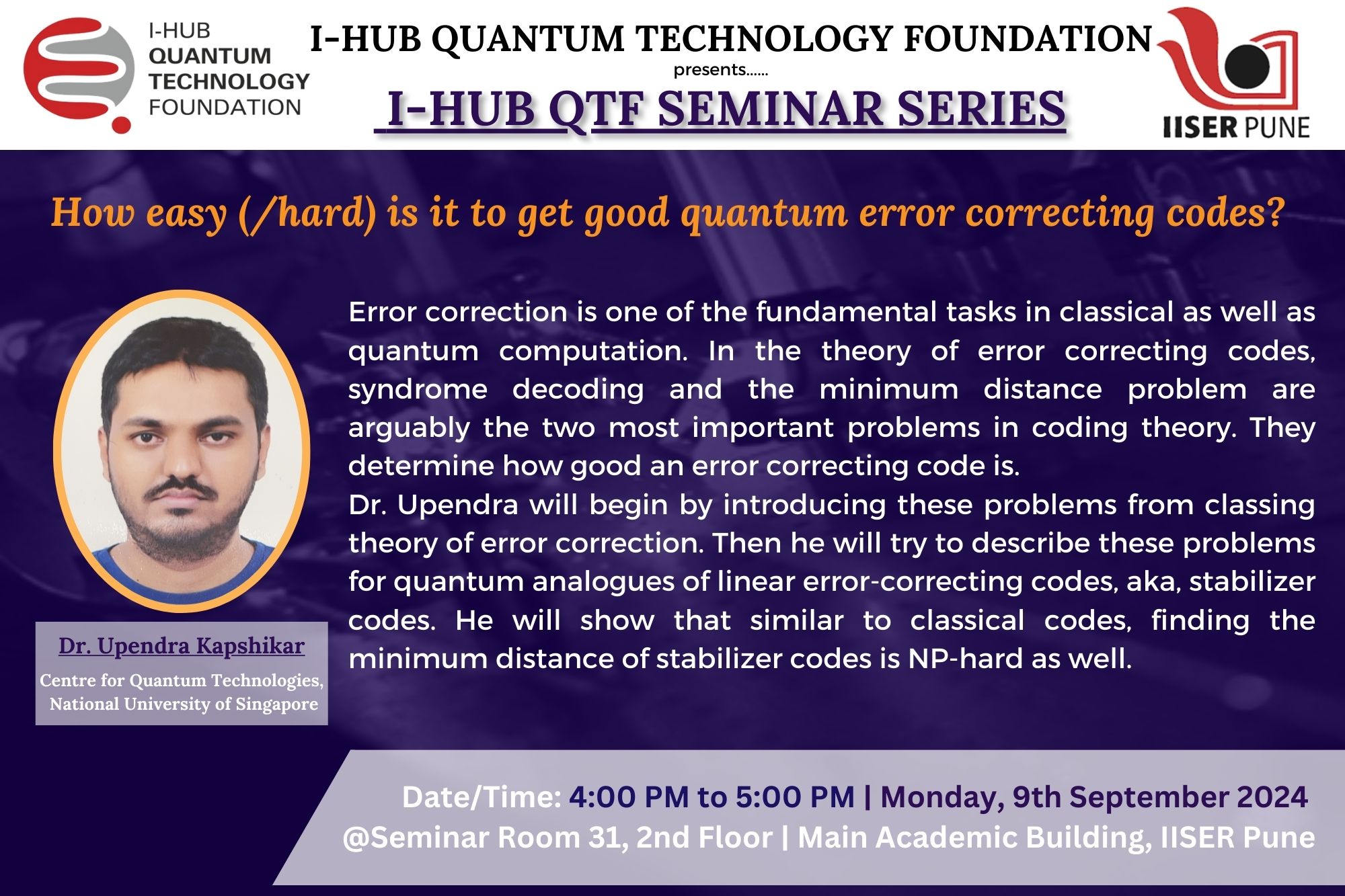
How easy (/hard) is it to get good quantum error correcting codes?

Event image
September 09, 2024, 04:00 PM - 05:00 PM

Venue

Seminar Room No. 31, 2nd Floor, Main Academic Building, IISER, Pune Speakers

Speakers

Dr. Upendra Kapshikar, Centre for Quantum Technologies, National University of Singapore

Abstract

I-HUB QUANTUM TECHNOLOGY FOUNDATION

presents......

I-HUB QTF Quantum Seminar Series

Academic Research on Global Challenges

Date/Time: 4:00 PM to 5:00 PM | Monday, 9th September 2024 

Error correction is one of the fundamental tasks in classical as well as quantum computation. In the theory of error correcting codes, syndrome decoding and the minimum distance problem are arguably the two most important problems in coding theory. They determine how good an error correcting code is. Dr. Upendra will begin by introducing these problems from classing theory of error correction. Then he will try to describe these problems for quantum analogues of linear error-correcting codes, aka, stabilizer codes. He will show that similar to classical codes, finding the minimum distance of stabilizer codes is NP-hard as well.

Quantum Materials & Single Crystal Growth

Research-ready materials developed to your requirements.

I-HUB QTF provides advanced materials and high-quality single crystals for research in quantum materials and emerging quantum technologies, with capabilities spanning material synthesis, crystal growth and characterization.

What We Offer

Materials and Crystal Solutions for Your Research

Our capabilities extend beyond supplying standard materials. We work with researchers to develop and provide materials suited to specific research requirements.

1) Single Crystal Growth

Growth of high-quality single crystals for quantum materials research, with controlled composition and crystal structure.

2) Advanced Materials

A range of materials exhibiting electronic, magnetic, topological, superconducting and strongly correlated phenomena.

3) Custom Material Development

Materials not currently listed in our portfolio can also be considered based on specific research requirements and feasibility.

4) Material Characterization

Characterization of synthesized materials to assess structural, compositional and other relevant properties.

Read more